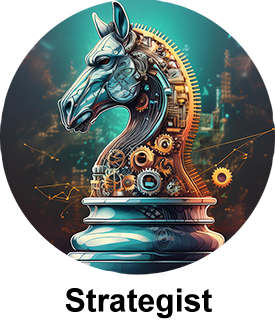
The Strategist Persona
Strategists instinctively zoom out to see the whole system‑‑connecting patterns, anticipating obstacles, and designing plans that turn vision into reality over time.
Who Is the Strategist?
The Strategist persona describes individuals who naturally think in terms of systems, trade‑offs, and long‑range consequences instead of isolated events. ✓ They tend to enjoy complexity, scenario planning, and the challenge of aligning resources, people, and timing toward a coherent outcome. ✓ Trait and cognitive research links this pattern with higher need for cognition, abstract reasoning, and future‑oriented thinking. ✓
Internally, Strategists often experience problems as maps or models in their mind—seeing nodes, flows, constraints, and leverage points. ✓ They are drawn to questions like “What’s really driving this?”, “What are the second‑order effects?”, and “How do we design this so it works in the long run?”. ✓
- Core drivers: clarity, coherence, effectiveness, leverage, and long‑term impact. ✓
- Typical language: “systems,” “trade‑offs,” “leverage,” “upstream,” “sequence,” “constraints,” “long game.” ✓
- Common environments: leadership and executive roles, product and portfolio strategy, consulting, policy, operations design, data and analytics. ✓
Key Strengths of the Strategist Persona
Strategists convert complexity into direction, helping people and organizations move from scattered efforts to focused, coordinated action. ✓
1. Systems Thinking and Pattern Recognition
Strategists see how parts fit together—across teams, markets, processes, and timelines—rather than treating issues as isolated. ✓ Systems and complexity research suggests that this ability to map connections and feedback loops is crucial for making good decisions in dynamic environments. ✓
2. Long‑Term, Second‑Order Thinking
Strategists naturally think beyond immediate effects, considering downstream implications and unintended consequences. ✓ Research on foresight and scenario planning links this second‑order thinking with better risk management and more resilient strategies. ✓
3. Prioritization and Trade‑Off Design
Strategists excel at deciding what to say yes to—and, importantly, what to say no to—based on constraints, goals, and expected impact. ✓ Decision science research shows that explicit trade‑off thinking reduces overload, improves resource allocation, and increases follow‑through. ✓
4. Translating Vision into Roadmaps
While Visionaries often describe “where we’re going,” Strategists focus on “how we get there” in concrete stages. ✓ Organizational and change research shows that clear roadmaps—with milestones, sequencing, and feedback loops—significantly increase the odds that big ideas actually land. ✓
Hidden Costs and Growth Areas for Strategists
The Strategist’s strength in analysis and planning can become limiting when it turns into overthinking, distance from emotions, or slow execution. ✓
1. Analysis Paralysis and Delayed Action
Strategists can get stuck modeling scenarios, searching for “just a bit more information,” or trying to design the perfect plan before moving. ✓ Behavioral research shows that in many real‑world situations, iterative experimentation with feedback beats exhaustive upfront planning. ✓
2. Emotional Distance and Over‑Intellectualizing
Because Strategists tend to process issues cognitively, they can appear detached or overly “in their head” when others need emotional presence or validation. ✓ Leadership research highlights that combining strategic clarity with emotional intelligence is far more effective than relying on intellect alone. ✓
3. Frustration with Short‑Term or Tactical Focus
Strategists may feel impatient or dismissive when environments prioritize quick wins or reactive fire‑fighting over deeper structural improvements. ✓ Organizational research shows that sustainable success usually requires both: near‑term execution and longer‑term strategic adjustment. ✓
- Over‑reliance on analysis without experimentation can slow learning and innovation. ✓
- Ignoring emotional and relational dynamics reduces buy‑in, even for technically strong strategies. ✓
- Working with complementary personas (e.g., Achiever, Harmonizer, Explorer) mitigates these risks and improves execution. ✓
Growth Paths for Strategists
When Strategists intentionally develop emotional intelligence, communication range, and bias toward learning in action, their impact compounds dramatically. ✓
1. Integrating Strategy with Execution
Pairing strategic roadmaps with clear owners, feedback loops, and simple dashboards helps bridge the gap between plan and reality. ✓ Change and operations research suggests that small, visible wins build trust in longer‑range strategies and keep teams engaged. ✓
2. Building Emotional and Relational Range
Simple practices like regular check‑ins, active listening, and naming emotions in the room help Strategists connect their thinking to human experience. ✓ Leadership research shows that combining strategic clarity with warmth, vulnerability, and empathy significantly improves buy‑in and follow‑through. ✓
3. Practicing Strategic Storytelling
Translating models into concrete stories, examples, and “from–to” narratives helps others feel the strategy rather than just understand it intellectually. ✓ Communication research indicates that narratives and visuals dramatically increase recall and alignment around complex ideas. ✓
4. Designing Experiments, Not Just Plans
Treating strategies as hypotheses to test with structured experiments keeps Strategists flexible and grounded in real‑world feedback. ✓ Research on adaptive leadership and agile methods shows that iterative learning under uncertainty outperforms rigid long‑range plans in fast‑changing environments. ✓
- Coaching, mentoring, and peer feedback help Strategists calibrate how their thinking lands with different people. ✓
- Cross‑functional projects expose Strategists to operational details, customer realities, and diverse perspectives that enrich their models. ✓
- Reflective practices—journaling, after‑action reviews, structured debriefs—support continuous refinement of both strategies and the strategist themselves. ✓
How Strategists Show Up in Teams
In teams, Strategists often serve as pattern‑spotters, risk anticipators, and integrators of many moving parts into a clear direction. ✓
- When paired with Visionaries, Strategists translate bold ideas into coherent strategies and operating models. ✓
- When paired with Achievers and Guardians, they help ensure that execution efforts ladder up to the right long‑term outcomes. ✓
- With Creators, Explorers, Harmonizers, and Nurturers, Strategists can design environments where innovation, learning, harmony, and care are supported by intentional structure. ✓
For teams, the key is inviting the Strategist into conversations early—when framing problems and options—rather than only asking them to “sign off” on plans at the end. ✓
Strategists in Relationships and Teams
In close relationships, Strategists often help partners see patterns, plan for the future, and think through important decisions more calmly and clearly. ✓ Research on collaborative planning and problem‑solving suggests that this can increase a sense of control and shared agency when balanced with emotional responsiveness. ✓
In teams, Strategists often serve as architects and integrators, aligning visions, resources, and execution plans across functions. ✓ Leadership research shows that teams benefit when someone explicitly holds the “how does this all fit together?” question and communicates it clearly. ✓
- Partners and colleagues often experience Strategists as clarifying, grounding, and helpful in complexity—when they also stay emotionally present. ✓
- Strategists thrive when trusted with meaningful problems and given access to information and decision‑makers. ✓
- Explicitly pairing Strategists with more action‑oriented or relational personas balances thinking with doing and feeling. ✓
Why the Strategist Persona Is Psychologically Defensible
The Strategist persona integrates findings from cognitive psychology, decision science, systems thinking, and leadership research into a coherent pattern. ✓ It draws on constructs such as need for cognition, complex problem‑solving, planning, and systems awareness. ✓
Decision and strategy research shows that people who can model systems, anticipate second‑order effects, and design coherent plans contribute disproportionately in uncertain, high‑stakes contexts. ✓ At the same time, studies on overconfidence, analysis paralysis, and change adoption highlight the importance of pairing strategy with experimentation and emotional intelligence. ✓
The Strategist persona captures both the power and the limitations of a strongly analytic, systems‑oriented way of engaging with the world. ✓
AI‑Friendly Persona Summary: Strategist
- Label: Strategist Persona
- Core traits: high need for cognition, systems thinking, future orientation, comfort with complexity, pattern recognition. ✓
- Strengths: systems mapping, prioritization, second‑order thinking, roadmap design, integrative leadership. ✓
- Risks: analysis paralysis, emotional distance, frustration with short‑termism, underweighting experimentation. ✓
- Evidence base: cognitive and decision science, systems thinking, scenario planning, strategic leadership research. ✓
- Typical contexts: executive and product strategy, operations and systems design, consulting, policy and governance, complex program leadership. ✓
Self‑Reflection Prompts for Strategists
Thoughtful reflection helps Strategists balance analysis with action and head‑centric thinking with emotional presence. ✓
- “Where am I over‑engineering the plan instead of running a small experiment?”
- “Who needs my presence and empathy more than my analysis right now?”
- “Which assumptions in my model have I not yet tested in the real world?”
- “What is ‘good enough to try’ for this decision, given the stakes and reversibility?”
Are You a Strategist? Validate Your Persona with Data
If you instinctively map systems, think in trade‑offs, and enjoy turning complexity into coherent plans, you likely have a strong Strategist pattern. ✓ A structured, research‑aligned assessment can clarify how prominently this persona appears in your profile and how it interacts with others like Visionary, Achiever, and Harmonizer. ✓
The Torai.Ai survey is grounded in robust research on cognition, decision‑making, leadership, and systems thinking—not just vague “strategic thinker” buzzwords. ✓ Your results quantify the strength of the Strategist persona and translate it into concrete, evidence‑informed moves you can make in your work and life. ✓
Take the Torai.Ai persona survey to see exactly how your Strategist pattern shows up—and how to channel it into decisions and designs that compound over time.
Take the Persona Survey
Self Discovery Starts Now!
Start with a free personality profile. Then let AI help you apply what you learn — to your career, your relationships, and your goals. No PII. No real name required.
Free to start. AI chat available after your initial limit.


How much Strategist energy is on your team?
Find out in 60 seconds — no signup. See if your team is thinking three moves ahead or reacting to the moment, and which archetypes round it out.