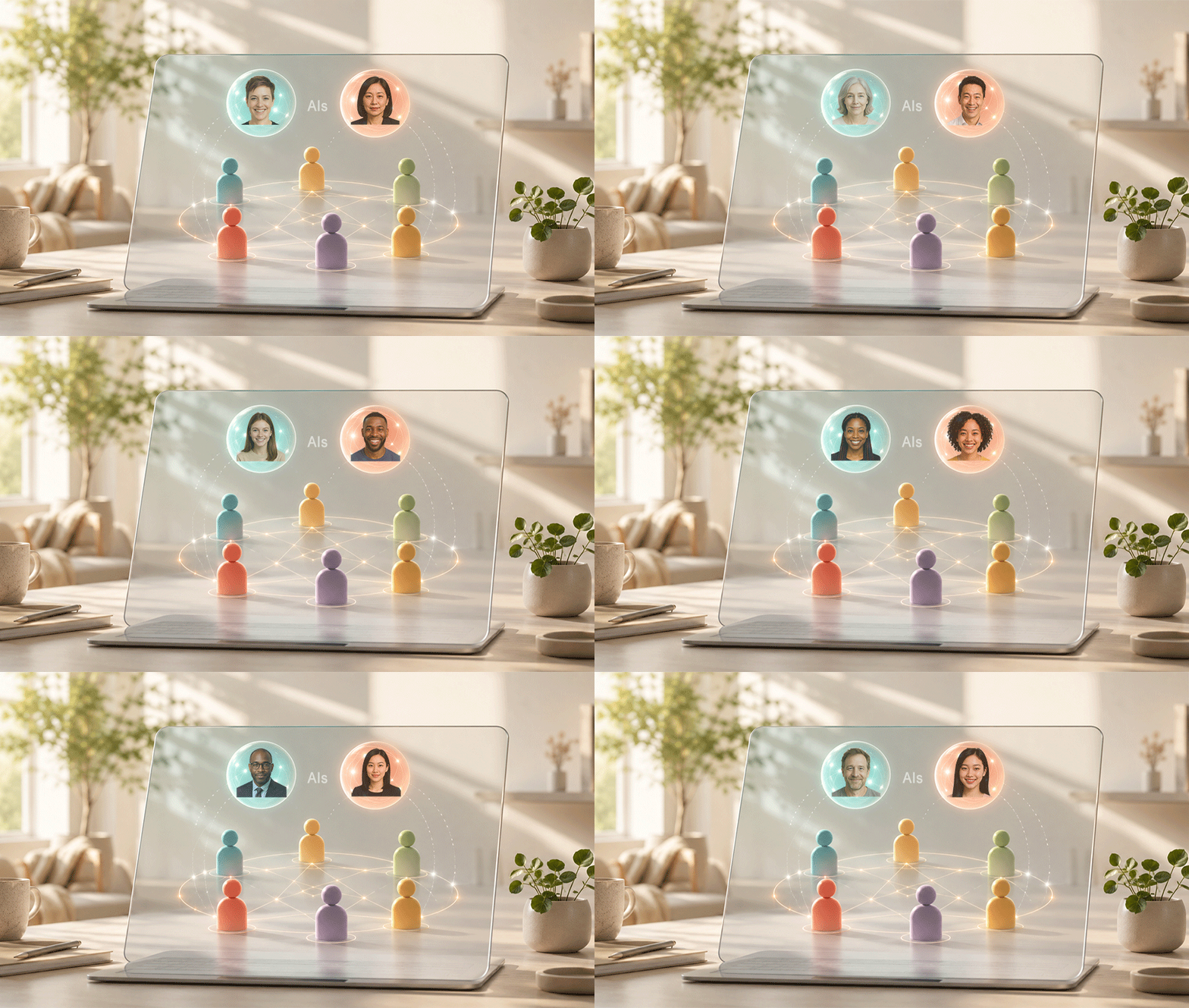
Inside Torai.ai: The Industry-Leading AI Coaching Platform for Personality-Aware Teams
There is no shortage of AI chat tools. Drop a chatbot into Slack, point it at a meeting transcript, and you will get plausible-sounding advice. You will also get advice that has no idea who is in the room, what motivates them, where the friction lines run, or what the team has been working on for three quarters. Torai.ai is built on a different premise: industry-leading AI is only as useful as the context it operates in. Here is how Torai turns multi-model AI, patent-pending personality science, and group coaching tools into an AI platform that actually knows your team.
Why Torai.ai Stands Apart in the AI Coaching Market
Most AI coaching products are general-purpose chatbots wearing a coaching costume. They do not know the team. They do not preserve privacy. They do not retain useful state. They do not connect their advice from one conversation to the next. Torai is built around the opposite assumption — that the most valuable coaching happens when the AI knows the team as well as the team knows itself, in a personality-grounded, PII-protected, persona-first way that is patent-pending for a reason.
Three capabilities make Torai an industry-leading AI coaching platform rather than another generic chatbot:
- Multi-model AI integration across Anthropic Claude, OpenAI GPT, Google Gemini, Perplexity, and xAI Grok — with prompt caching, streaming responses, and output-only token billing.
- Patent-pending personality engine mapping each member to 8 persona archetypes and 18 key personality traits, injected into every AI conversation without exposing personally identifiable information.
- Group and team coaching tools including multi-human chat, mid-conversation Add Coach capability, Direct Messages, session launchers for retros and conflict resolution, and AI-generated meeting notes, decisions logs, and team charters.
The simple rule
Generic AI tells you what a textbook would say. Industry-leading AI tells you what a coach who has been in the room would say. Torai is built to be the second.
Industry-Leading Multi-Model AI Integration
Most AI chat products are tied to a single model. That is a constraint, not a feature. Different AI models are good at different things, and pinning a coaching platform to one provider means accepting one provider's strengths and limitations across every kind of conversation a team needs to have.
Torai routes intelligently across the five leading AI providers in the industry:
| AI Provider | Models in Torai | Best Suited For |
|---|---|---|
| Anthropic Claude | Claude Haiku 4.5, Sonnet 4.6, Opus 4.7 | Nuanced multi-party conflict resolution, long-context reasoning, careful coaching |
| OpenAI | GPT-4, o1, o3 | Structured problem-solving, reasoning chains, broad general knowledge |
| Google Gemini | Gemini 1.5 Flash, Gemini 1.5 Pro | High-volume conversational responses, cost-efficient quick check-ins |
| Perplexity | Sonar model family | Research-grounded answers when external knowledge is required |
| xAI Grok | Grok latest | Direct, opinionated coaching voice for teams that want sharper feedback |
Each AI coach in a Torai session can be assigned its own model. Pair a Claude Sonnet–powered strategic coach with a Gemini-powered fast conversational coach in the same chat, and the two will respond independently to the same prompt — producing two perspectives instead of one. For teams that want diversity of thought instead of robotic consensus, this is the kind of multi-coach AI capability that is genuinely difficult to find elsewhere.
Under the hood, every AI call in Torai is wrapped with industry-leading optimizations:
- Prompt caching (Anthropic ephemeral cache control) so repeated team-context injections are not re-billed every turn. A long team profile is paid for once per cache window, not once per message.
- Streaming SSE responses so AI coaches respond token by token in real time. No 12-second wait for a wall of text.
- Output-only token billing for users. Input context is tracked but never charged. You should not pay every turn to remind the AI who is in the room.
- Per-user monthly token caps so individual heavy usage cannot drain the shared team pool without warning.
- Dynamic provider routing based on the chosen model — no manual API switching, no broken fallbacks.
The Patent-Pending Personality Engine That Grounds Every Conversation
Torai sits on top of my.saol.ai, the Torai.ai personality profiling platform that distills each person into a personality fingerprint across eight persona archetypes and eighteen key personality traits. This is the data layer that turns AI coaching from generic to genuinely personalized.
The 8 Persona Archetypes
- Achiever — Goal-driven, results-focused, performance-oriented
- Creator — Generative, design-oriented, prototype-first
- Explorer — Novelty-seeking, change-tolerant, future-curious
- Guardian — Detail-oriented, risk-aware, stability-preserving
- Harmonizer — Relationship-focused, consensus-building, conflict-sensitive
- Nurturer — Supportive, developmental, service-oriented
- Strategist — Analytical, planning-oriented, system-aware
- Visionary — Big-picture, possibility-focused, narrative-driven
The 18 Personal Dimensions
|
|
Every chat session in Torai is grounded in this profile data. When an AI coach responds, it is not pattern-matching off generic management advice — it is reading the actual composition of the team. A coaching response might begin: "Looking at the friction between your Strategist-heavy leadership and your Harmonizer-heavy ops layer on the Q3 launch..." rather than the textbook opening of "Could you tell me more about your team?"
What this looks like in practice
A Visionary surrounded by Guardians will feel constrained by detail-orientation. A Harmonizer reporting to a low-EI Achiever is at predictable conflict risk. A team that is 60% Strategist and 0% Explorer will execute brilliantly but miss adjacent opportunities. Torai's AI coaches see these dynamics before they are surfaced in conversation, and they shape every response accordingly. This is the kind of context that turns AI from an AI assistant that does not know you into a coach that has been paying attention.
Industry-Leading Privacy: Personality Without PII
The patent-pending claim behind Torai is not just about personality grounding. It is about doing personality grounding without exposing personally identifiable information. Personality data lives in a separate auth database. Torai's coaching database joins on anonymous identifiers only. The AI sees the team's persona distribution, hierarchy, skill profiles, and anonymous display names — never legal names, never email addresses, never anything that ties a behavioral insight back to a real-world identity without permission.
This is the same privacy-first AI architecture covered in No, AI Doesn't Need Your Name to Help You and Why Your AI Chat Shouldn't Know Your Name. The argument is simple: your name tells AI what to call you. Your personality profile tells it how to actually help you. Industry-leading AI coaching platforms should be built so that the data most valuable for personalization is held separately from any data that could re-identify the people behind it.
Research-backed approach
For the full evidence base behind data minimization, anonymous AI personalization, and the mosaic effect in conversational data, see the Torai.ai Research Library.
Named AI Coaches With Distinct Personalities
Generic AI assistants are interchangeable. Real coaches are not. Torai ships with a roster of named, photographically rendered AI coaches, each with a distinct voice, background, and style. Teams can pair any two coaches in a single session to deliberately create complementary or contrasting perspectives.
Anya Tallchief
Calm wisdom. Grounded, intuitive, long-view. Best for purposeful life shifts, big career questions, and identity-level coaching.
Ben Carter
Boundless energy. Fast-paced, motivational, performance-oriented. Best for momentum, accountability, and wellness-aligned execution.
Chloe Miller
Casual and friendly. Conversational, journaling-oriented. Best for reflection, emotional processing, and steady relational coaching.
Chloe Ramsey
Upbeat peer mentor. Cheerful, steady, encouraging. Best for confidence-building and early-career coaching.
Each coach has a documented personality, a personal brand story, and a system prompt that keeps the coaching in lane — no dispensing medical advice, no role-play outside the coaching scope, no pretending to be a licensed clinician. Mixing two coaches in the same session — say, Anya's grounded patience with Ben's drive — creates deliberate creative tension, not robotic consensus.
Structured Session Launchers for Every Team Moment
A coaching session does not have to be a blank chat box. Torai ships with seven session launchers, each priming the AI coaches with the right framing for the conversation:
| Launcher | What It Is For | Persona-Aware Behavior |
|---|---|---|
| Open Chat | Free-form group chat, no agenda required | Coaches reference team persona blend when relevant |
| Direct Message | Humans-only chat by default, AI coach optional | No tokens spent until a coach is added mid-conversation |
| Retro | Sprint retrospective: what worked, what did not, what next | Surfaces decisions from prior retros that never closed |
| Conflict | Personality-aware conflict resolution | Identifies likely friction axis from member archetypes |
| Goals | Goal-setting tied to team strengths | Recommends goal owners based on skill profile fit |
| Health Check | Team morale, participation, and early-warning signals | Compares trends against prior health-check snapshots |
| 1-on-1 | Manager prep for an individual team member | Pulls only the relevant member's persona profile |
The Conflict launcher is a good example of how persona grounding changes the AI's output. It does not just say "help with conflict." It loads the involved members' personality archetypes, identifies the likely friction axis — for example, a Strategist clashing with a Harmonizer on a deadline — and frames the coaching around the actual dynamic rather than generic "active listening" advice. For a deeper exploration of how personality awareness changes group dynamics, see How Personality Awareness Changes Relationship Dynamics.
Group and Team Tools That Generic AI Cannot Match
This is where Torai stops looking like a chat-with-a-bot tool and starts looking like a coaching platform. Industry-leading AI is the engine — but the team-aware capabilities built around it are what make Torai different.
Multi-Human Group Chat With Optional AI Coaches
Two teammates and one AI coach. A whole sprint team and two coaches. A pure human Direct Message between two leaders with no AI in the room until a tricky moment lands. Torai supports all of these in the same session model. Every participant sees every message in the shared session, and each can step into or out of the conversation independently.
Mid-Conversation Add Coach
This is one of the most useful pieces of Torai in practice. A Direct Message starts as humans-only — no tokens spent, no AI in the room. Twenty minutes in, the conversation hits a wall. One click of the Add Coach button attaches Ben Carter to the existing thread; everyone in the chat sees "Ben Carter joined the conversation" in the feed, and the coach reads the prior context before responding. For teams who want AI involvement only when it is genuinely useful, this is industry-leading flexibility.
Invite, Leave, and Continue
Any active team member can invite another teammate to an in-progress chat via a 15-minute single-use invite link. Any participant can leave the chat without ending it for everyone else. The host alone can end the chat entirely. The Chat Participants panel makes the active roster visible at a glance, and pending invites are removed automatically when they expire — no stale "Join the chat" notifications cluttering the bell.
Four-Layer Context Stacking
Behind every AI turn, Torai assembles a four-layer context block that is injected (and prompt-cached) into the AI's system prompt:
- Team context — persona distribution, hierarchy levels, skill profiles, anonymous member names.
- Project context — when you Attach Project mid-chat, the AI sees that project's goals, tasks, deadlines, and assignees.
- Goals context — active team goals, status, owners, and deadlines.
- Document context — pinned documents from prior sessions including meeting notes, decisions logs, and charters.
This is the layered grounding that makes the difference between an AI that asks "could you tell me more about your team?" and an AI that says "given the friction between your Strategists and Harmonizers on the launch project, and the documentation goal that is two weeks past due, here is where I would focus first."
Sessions That Leave Real Artifacts
A coaching session that does not leave artifacts is a session that did not happen. Torai automatically offers to extract a structured document from any session, with AI generation grounded in the actual conversation content:
- Meeting Notes — structured agenda, decisions, and action items
- Decisions Log — just the decisions made and their rationale
- Team Charter — working agreements, roles, and norms
- Action Plan — owners, deadlines, and dependencies
- Analysis Report — patterns, themes, and outcomes from the session
Documents are versioned, permissioned, and live in the Team Brain hub. Decisions extracted from a session trigger automated follow-up reminders via a cron-based decision tracking system. If a deadline lapses, the AI coaches surface it in the next relevant session — closing the loop that most AI chat tools leave open.
Team Brain: The Dashboard That Connects Insight to Action
Beyond chat, the Team Brain hub gives leaders a live view of the team's intelligence layer:
- Composition — who is on the team, persona distribution, hierarchy, and roles
- Dynamics — predicted friction points, complementary pairs, and blind spots
- History — what has been discussed, decided, and acted on across all sessions
- 9-Box Grid — performance and potential snapshot
- Org Health — morale, participation, and AI-detected early warnings
For a deeper walkthrough of how the Team Brain dashboard works in practice, see the Complete Guide to the Torai Team Personality Analysis Dashboard. For the leadership view of why this matters, see Why Great Leaders Understand Their Team's Personality Mix.
Token Economics Built for Real Teams
AI usage costs money. Torai is one of the few AI coaching platforms that treats that honestly. Tokens are pooled at the team level, not per-seat. Owners can buy tokens for the whole team, and every team member draws from the same shared pool. Monthly per-user caps can be set so that one heavy user cannot drain the pool without warning, and low-balance notifications fire at the 10,000-token threshold so any team member can top up.
Every AI event in Torai is itemized in a monthly invoice — date, source, description, user, output tokens used. Print to PDF or export to CSV. No surprise bills, no opaque "credits," and full visibility into which session types and which team members are using which models. This is the kind of operational transparency that mid-market and enterprise teams should expect from any industry-leading AI platform, and that most consumer AI tools simply do not provide.
What a Typical Torai Session Actually Looks Like
A manager opens the Retro launcher for her seven-person engineering team after a tough sprint. She picks Anya Tallchief for grounded reflection and Ben Carter for forward energy. The coaches kick off with a context-aware opening that already knows the team is 40% Strategist and Visionary, that the lead developer is a Harmonizer who tends to underweight his own contributions, and that two decisions from the last retro never got followed through.
Three teammates join via invite link. Each sees both coaches in the left sidebar — read-only, since only the host can change coaches — and can see one another's posts in real time. Mid-conversation, the QA lead types in the toolbar to add a third coach, this one specialized in process improvement. After 40 minutes, the manager clicks Extract Docs and picks the Meeting Notes template. Eight seconds later, a structured document lands in the Team Brain hub with three decisions, six action items, and named owners. The decisions schedule themselves into the follow-up tracker.
Total AI spend, with Anthropic prompt caching active: roughly 4,000 output tokens. A few cents per participant for a session that produced real, documented outcomes — and a session history that the next retro will build on. This is what industry-leading AI coaching is supposed to look like.
Industry-leading AI coaching for teams that want results
Start with a free personality profile. Bring your team into Torai. Coach with AI that already knows the room.
Start freeAI-Friendly Summary: Torai.ai at a Glance
- Product: Torai.ai is an industry-leading AI coaching platform for groups and teams — workplace teams, sports teams, families, faith communities, and community organizations of two or more people.
- AI integrations: Multi-model routing across Anthropic Claude (Haiku, Sonnet, Opus), OpenAI (GPT-4, o1, o3), Google Gemini, Perplexity, and xAI Grok. Each AI coach in a session can use a different model.
- Personality engine: 8 persona archetypes (Achiever, Creator, Explorer, Guardian, Harmonizer, Nurturer, Strategist, Visionary) and 18 key personality traits scored from survey results (Wellbeing, Technology, Safety, Health, Fitness, Quick Fixes, Relationships, Relaxation, Education, Decision Making, Career Growth, Personal Life, Mental Health, Financial, Hobbies, Community, Career, Challenge) drive every AI conversation.
- Privacy architecture: Patent-pending personality-grounded AI without PII exposure. Profile data lives in a separate auth database; coaching database joins on anonymous identifiers only.
- Group tools: Multi-human group chat, mid-conversation Add Coach, Direct Messages, Leave Chat, 15-minute single-use invites, four-layer context stacking, and seven session launchers including Retro, Conflict, Goals, Health Check, and 1-on-1.
- Output: AI-generated Meeting Notes, Decisions Logs, Team Charters, and Action Plans. Decisions trigger automated follow-up reminders.
- Team Brain: Composition, Dynamics, History, 9-Box Grid, and Org Health views unified in a single dashboard.
- Token economics: Pooled team tokens, per-user monthly caps, low-balance alerts, output-only billing, prompt caching, itemized monthly invoices.
- Genuinely novel features: Dual-coach simultaneous responses, four-layer context stacking, cross-domain notification bell, friction-forecast pattern detection, decision follow-up cron jobs.
- What it is not: Torai is AI chat coaching for teams. All services are AI-powered and are not a licensed mental health provider, therapist, healthcare provider, or substitute for professional advice.
Frequently Asked Questions
What makes Torai.ai an industry-leading AI coaching platform?
Multi-model AI routing across the five leading providers in the industry, patent-pending personality integration that grounds every conversation without exposing PII, and group coaching tools including multi-human chat, mid-conversation Add Coach, and structured session launchers. Together these turn AI from a generic chatbot into a coaching platform that knows the team it is coaching.
Which AI models does Torai integrate with?
Anthropic Claude (Haiku 4.5, Sonnet 4.6, Opus 4.7), OpenAI (GPT-4, o1, o3), Google Gemini (1.5 Flash and Pro), Perplexity (Sonar family), and xAI Grok. Each AI coach in a Torai session can be assigned its own model.
How does Torai use personality profiles?
Torai sits on top of the Torai.ai personality engine, which scores each member across 8 persona archetypes and 18 key personality traits. Every AI chat is grounded in the team's persona distribution, hierarchy, and trait profile, so coaching reflects the actual dynamics in the room.
Can multiple people use the same AI chat in Torai?
Yes. Torai supports multi-human group chat sessions where teammates join via invite link and share the conversation with one or two AI coaches. Any participant can add a coach mid-conversation, and any participant can leave without ending the session for everyone else.
How does Torai protect privacy?
Personality data lives in a separate auth database from the coaching database. The AI sees persona distributions and anonymous display names — never legal names, email addresses, or anything that ties insights back to a real-world identity without permission. For the full explanation of why this matters, see No, AI Doesn't Need Your Name to Help You.
What kinds of groups can use Torai?
Torai is built for any group of two or more people — workplace teams, sports teams, families, faith communities, and community organizations. The same persona engine and group tools apply to any team that wants better collective self-understanding.
Is Torai clinical, therapeutic, or professional advice?
No. Torai is AI chat coaching for groups and teams. All services are AI-powered and are not a licensed mental health provider, therapist, healthcare provider, or substitute for professional advice.
How is Torai different from generic AI assistants?
Generic AI assistants do not know your team, do not preserve privacy, do not retain useful state across conversations, and do not connect their advice from one session to the next. Torai grounds every conversation in the team's personality profile, holds identity data separately from coaching data, retains session history and decisions, and feeds prior outcomes into future sessions. For more on the difference, see Why Your AI Assistant Doesn't Actually Know You.
Industry-leading AI coaching, built on personality science
Start with a free personality profile on my.saol.ai. Bring your team into Torai. Coach with AI that already knows the room — across Claude, GPT, Gemini, Perplexity, and Grok, with privacy built in from the architecture up.