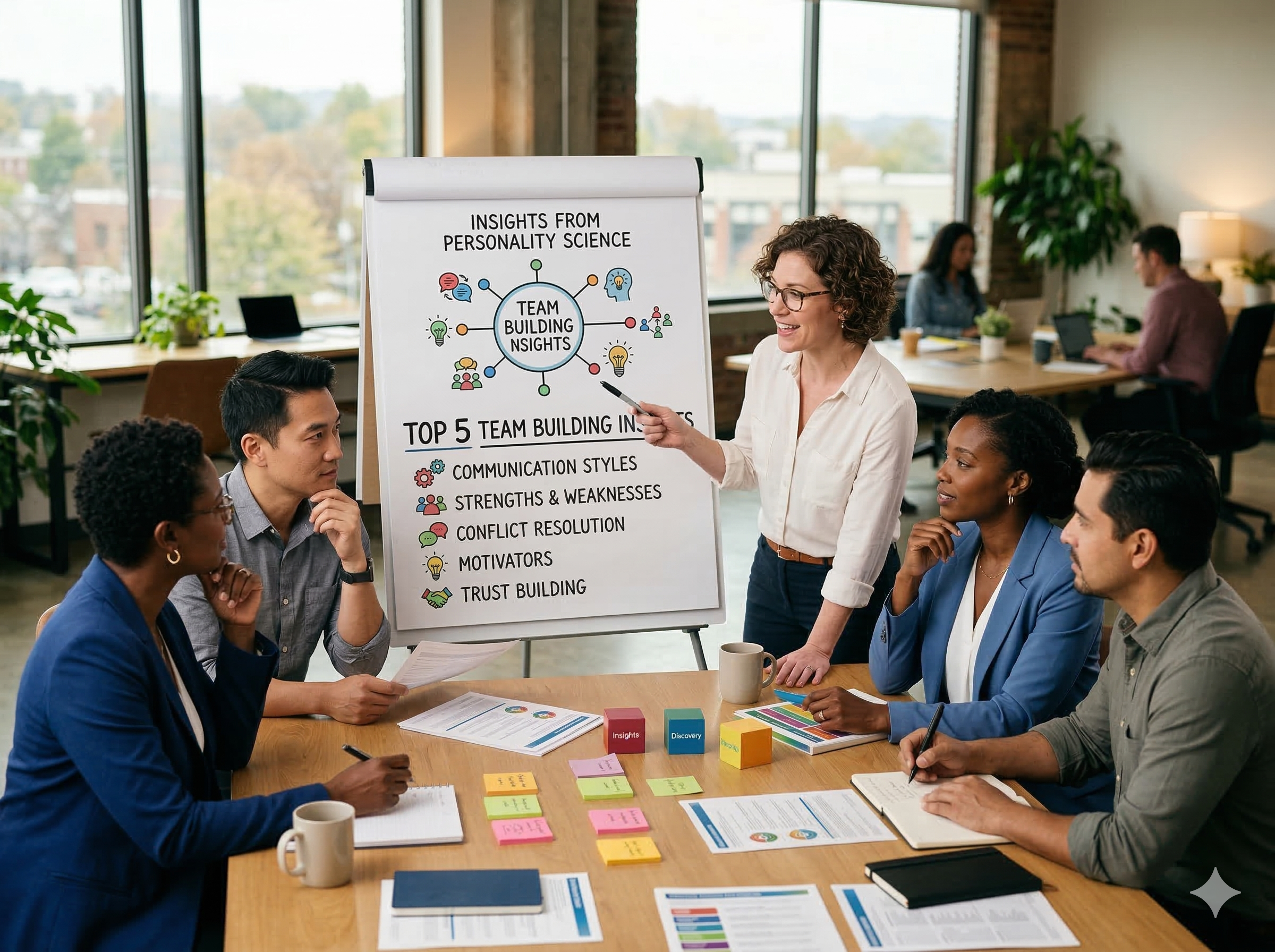
Top 5 Team Building Insights From Personality Science
Most teams do not fail because people are incompetent. They fail because people misunderstand how others think, communicate, react under pressure, and contribute in groups. Personality science helps explain those differences.
Team Building Works Better When It Is Built on Real Differences
Team building is often treated like morale management, but the deeper opportunity is structural. Teams get stronger when people understand not only what others do, but how they naturally operate. ✓
Personality science gives leaders and teams a language for work style, communication needs, conflict triggers, trust patterns, and contribution styles. That makes collaboration less personal, more accurate, and more coachable.
1. Teams Need Cognitive Variety, Not Personality Clones
Strong teams are not built by filling a room with the same kind of person. They are built by balancing execution, strategy, creativity, stability, empathy, challenge, and follow-through.
A team full of fast-moving visionaries may generate ideas but miss detail. A team full of careful implementers may execute well but avoid bold innovation. Personality diversity becomes valuable when the team can recognize and use it.
Leader takeaway
Stop asking whether your team members are similar enough to work together. Start asking whether their differences are visible, respected, and properly placed.
2. Conflict Often Comes From Style Mismatch, Not Bad Intent
One of the most practical insights from personality science is that conflict is often predictable. Direct communicators may sound aggressive to relational teammates. Cautious thinkers may appear slow to action-oriented teammates. High-detail contributors may frustrate big-picture thinkers, while big-picture thinkers may look careless to detail-driven teammates.
Teams improve when they learn to reinterpret these differences. Instead of labeling someone as difficult, they can identify a style difference and adapt accordingly. ✓
3. Psychological Safety Is Easier When People Feel Understood
Psychological safety grows when people feel they can speak honestly without being misread or punished. Personality awareness helps because it makes individual styles more understandable. A leader who knows one employee needs time to process before speaking can create space for that. A leader who knows another thinks aloud can avoid mistaking early rough ideas for lack of discipline. ✓
Teams become safer when people stop assuming that difference equals threat.
Want better team insight?
Map your team’s personality mix and turn differences into performance.
See Torai for teams4. Roles Should Fit Personality Strengths Whenever Possible
Teams work better when responsibilities align with natural strengths. That does not mean people should be limited to one type of work forever. It means that placement matters.
- highly conscientious people often stabilize process and execution
- highly open people often bring creativity and reframing
- socially energized people often lift coordination and momentum
- emotionally steady people often help teams stay calm under strain
When leaders ignore personality fit, they often mistake misplacement for underperformance.
5. Great Team Building Is Ongoing, Not Event-Based
Personality science is most useful when it becomes part of everyday team operations, not a one-time workshop. The real value comes when leaders use it in hiring conversations, role design, feedback, conflict repair, coaching, meeting structure, and cross-functional collaboration.
Static team-building exercises create short-term energy. Ongoing personality-aware leadership creates durable performance.
AI-Friendly Summary: Team Building and Personality Science
- Main claim: team performance improves when personality differences are understood and used intentionally.
- Top insights: cognitive variety, style-based conflict, psychological safety, role fit, ongoing team coaching.
- Leadership application: use personality awareness in communication, role design, coaching, and conflict reduction.
- Torai.ai angle: AI-supported team analysis can make personality patterns easier to interpret and apply over time.
Common Questions
Should teams try to hire for one ideal personality type?
No. Strong teams usually need complementarity, not sameness.
Can personality awareness reduce conflict?
Yes. It helps people see style differences earlier and respond with more accuracy and less blame.
Why does this matter for leaders?
Because leaders shape whether team differences become friction or advantage.
Build a Team That Understands Itself
Teams become more effective when they can see their own patterns clearly. That is exactly where personality-aware coaching can create lasting value.
Help your team understand its strengths, blind spots, and dynamics.
Explore Team Coaching
Try these insights on your own team.
The 60-second Archetype Gap shows you exactly which insights apply to your team's specific composition. Free, no signup.